- 03 June 2026
- By Admin
Introduction to Complete Final Year Project Research and Documentation Support
Final year projects represent one of the most important milestones in a student’s academic journey. Whether studying engineering, computer science, business, social sciences, healthcare, or information technology, students are expected to complete research-based projects that demonstrate their understanding, technical capabilities, analytical skills, and ability to solve real-world problems. Complete final year project research and documentation support services provide structured guidance that helps students manage project complexity while improving research quality and project presentation.
For many students, balancing coursework, internships, exams, and project deadlines becomes challenging. A final year project often requires months of planning, data collection, development, testing, documentation, and revisions. Structured support services help students organize their workflow and complete projects more efficiently.
Professional project support focuses on improving research methods, documentation quality, project organization, and academic presentation while helping students navigate difficult project requirements.
Why Final Year Projects Are Important for Academic Success ?
Final year projects serve as practical demonstrations of a student’s academic abilities and technical knowledge. Universities use these projects to assess problem-solving skills, research capabilities, communication skills, and subject understanding.
A well-executed project offers several benefits including improved academic performance, stronger professional portfolios, increased confidence, and enhanced career opportunities.
Students often use final year projects when applying for internships, employment opportunities, graduate programs, or professional certifications.
Because of their importance, project quality significantly impacts future educational and professional pathways.
Research Planning and Topic Selection
Selecting the right project topic is one of the first and most critical decisions students make.
Strong projects usually involve relevant research areas, manageable objectives, available resources, and practical applications.
Project support services help students identify research gaps, problem statements, objectives, expected outcomes, and project feasibility.
One strong long-tail keyword naturally associated with this process is Professional Final Year Project Research and Development Services because students frequently require guidance when selecting meaningful topics.
Careful planning reduces future complications and improves project success rates.
Project Proposal Development
Before beginning project execution, students usually prepare proposals outlining project objectives, scope, methodology, and expected contributions.
Proposal development often includes background studies, research justification, problem definitions, timelines, and methodology planning.
Well-developed proposals improve approval chances and provide clear project direction.
Support services assist students in building structured proposals that align with institutional requirements.
Clear proposals also improve communication with supervisors and project evaluators.
Research Methodology and Data Collection
Research methodology defines how projects are conducted and validated.
Students may use qualitative methods, quantitative approaches, mixed research models, experiments, surveys, interviews, simulations, or observational studies.
A major challenge students face involves selecting methods that match project goals.
Support services help students understand sampling strategies, experimental design, data collection tools, and validation techniques.
Another strong long-tail keyword included naturally is Affordable Final Year Project Assistance for Students with Research Support because many students require help balancing affordability with academic quality.
Well-designed methodologies improve project reliability and increase academic credibility.
Technical Development and Project Execution
Many projects require practical implementation in addition to theoretical research.
Technical projects may involve software development, prototype creation, engineering design, data modeling, machine learning, networking systems, mobile applications, or business solutions.
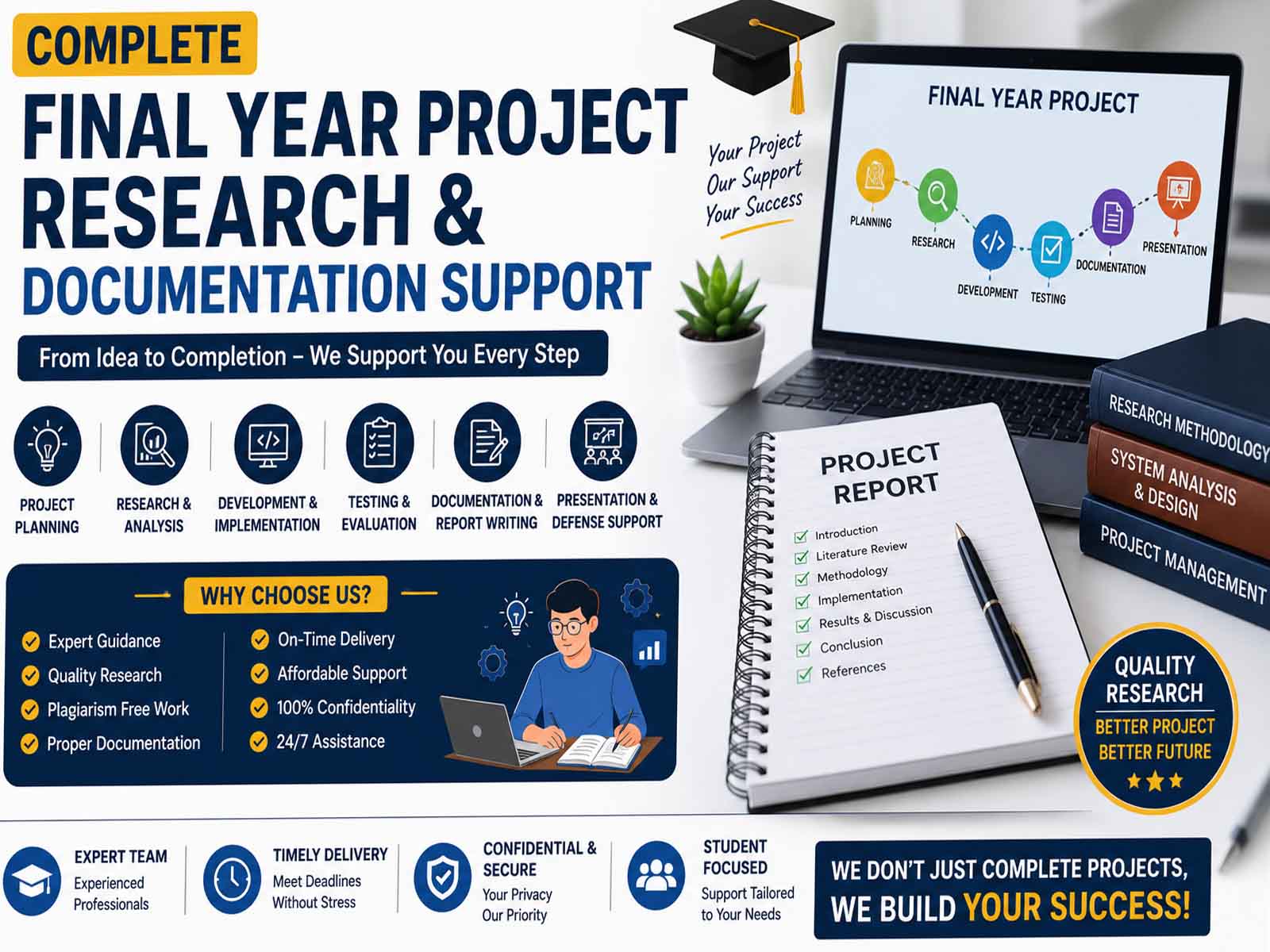
Execution phases often include planning, development, testing, optimization, and performance evaluation.
Project support services help students maintain organized workflows and reduce development delays.
Structured execution contributes significantly to project quality.
Documentation and Report Writing
Documentation represents one of the largest components of final year projects.
Project reports typically include introduction, literature review, methodology, implementation, findings, testing results, conclusion, and recommendations.
Proper documentation ensures project work is understandable, organized, and professionally presented.
Students often struggle with formatting consistency, technical writing quality, referencing, and report structure.
A powerful keyword frequently used within this area is Complete Final Year Project Research and Documentation Support Services because students require both technical and writing assistance.
Well-written reports improve evaluation outcomes and demonstrate professionalism.
Literature Review and Background Research
Strong projects require comprehensive background research.
Literature reviews help students understand previous studies, identify research gaps, compare methodologies, and establish theoretical foundations.
Effective literature reviews improve research depth, problem understanding, and project relevance.
Support services help students organize sources and synthesize information more effectively.
Well-researched projects often receive stronger academic evaluations.
Testing, Validation, and Performance Evaluation
Project testing ensures systems, models, and research findings function correctly.
Testing procedures may include performance testing, user testing, simulations, statistical validation, quality assurance, or usability assessments.
Validation demonstrates reliability, consistency, and effectiveness.
Students often require guidance selecting evaluation metrics and interpreting results.
Strong testing processes strengthen overall project credibility.
Citation, Referencing, and Academic Standards
Academic institutions require projects to meet strict documentation standards.
Common citation formats include APA, Harvard, IEEE, MLA, and university-specific styles.
Proper referencing supports academic integrity, credibility, and source transparency.
Support services assist students with reference management, citation formatting, plagiarism reduction, and source organization.
Maintaining academic standards strengthens project acceptance.
Time Management and Deadline Planning
Large projects often create scheduling challenges.
Students must manage research activities, practical work, documentation, revisions, and presentations.
Effective support services encourage milestone planning, progress tracking, deadline management, and productivity improvement.
Organized schedules reduce stress and improve completion rates.
Strong planning increases project efficiency.
Presentation Preparation and Project Defense
Completing a project also requires presenting findings effectively.
Presentation preparation includes slide creation, project summaries, visual aids, demonstration planning, and communication strategies.
Students benefit from understanding how to explain objectives, justify decisions, discuss findings, and answer evaluator questions.
Strong presentations improve confidence and enhance evaluation performance.
Benefits of Professional Project Support Services
Students receive several advantages from organized project support.
Benefits include better organization, stronger research quality, improved documentation, increased confidence, and more efficient project completion.
Support services simplify complicated processes while helping students develop stronger academic skills.
Professional guidance often reduces confusion and improves productivity.
Conclusion
Complete final year project research and documentation support services help students manage one of the most important phases of higher education. From topic selection and proposal development to implementation, documentation, testing, and presentation preparation, structured support improves project quality and academic performance.
As universities continue emphasizing research and practical learning, students who use organized support systems improve their ability to complete projects successfully while developing valuable skills for future careers and academic opportunities.