- 18 July 2026
- By Admin
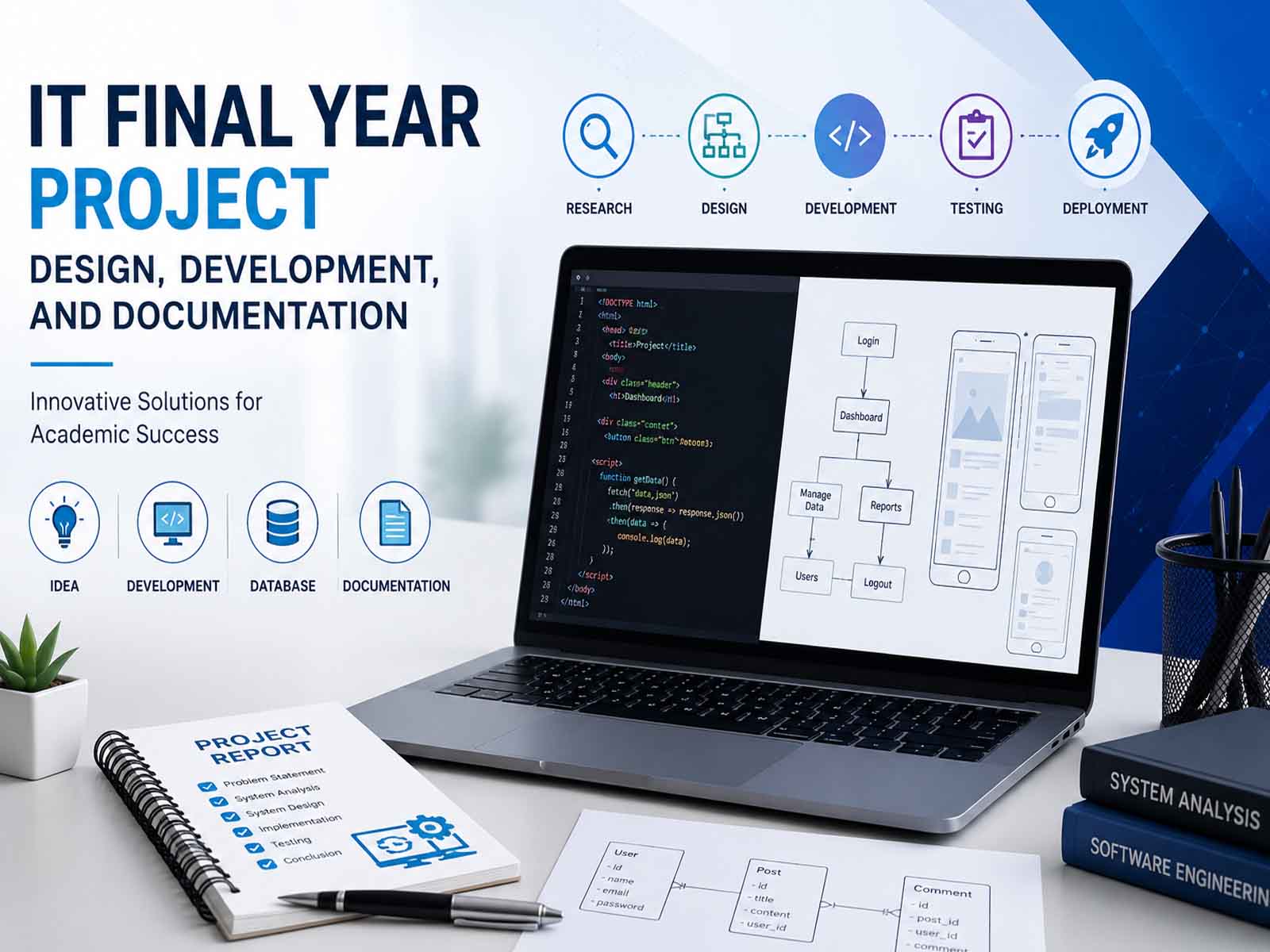
IT Final Year Project Design, Development, and Documentation
Introduction to IT Final Year Project Design, Development, and Documentation
For every student pursuing a degree in Information Technology, the final year project stands as the most significant academic milestone of their educational journey. It represents years of learning, technical practice, and academic growth combined into one comprehensive project. Professional Final Year Project Development and Documentation Services help students transform innovative ideas into successful academic projects by providing structured planning, technical implementation, and professional documentation that meets university standards.
The final year project is far more than a graduation requirement. It demonstrates a student's ability to solve real-world problems, develop software solutions, implement modern technologies, and prepare detailed technical reports. Universities evaluate not only the final product but also the research methodology, system design, implementation process, testing, and documentation. Proper planning and execution significantly improve the overall quality of the project.
This project also serves as a bridge between academic education and the professional software industry. Students apply programming, database management, networking, software engineering, and system analysis concepts to create a complete solution. Employers frequently review final year projects during interviews because they reflect practical skills, creativity, and problem-solving abilities.
Why the Final Year Project Matters ?
The final year project plays a crucial role in shaping a student's professional career. It allows students to work independently, make technical decisions, solve complex problems, and manage project timelines. These experiences prepare graduates for real-world software development environments where planning, teamwork, and technical excellence are equally important.
Many students seek Custom Final Year Project Solutions for University Students because every university follows different project requirements and evaluation criteria. Customized project planning ensures that the selected topic, technologies, documentation, and implementation align with departmental expectations while allowing students to showcase their technical strengths.
Academically, the project measures how effectively students integrate concepts learned throughout their degree program. A web application, mobile application, machine learning system, cybersecurity solution, or cloud-based platform requires combining multiple technical disciplines into one complete system. Successfully completing such a project demonstrates technical competence and professional readiness.
Professionally, the completed project becomes an important portfolio piece. Recruiters often ask graduates to explain the technologies used, architecture decisions, challenges faced during development, and testing methodologies. A well-designed and properly documented project creates a positive impression and increases employment opportunities.
Besides technical knowledge, students also develop valuable soft skills including communication, project management, analytical thinking, teamwork, and documentation writing. These skills are highly valued across the IT industry and contribute significantly to long-term career success.
Choosing the Right Project Topic
Selecting the right project topic is one of the most important decisions in the entire project lifecycle. The chosen topic should solve a genuine problem, remain technically achievable within the available timeframe, and match the student's interests and future career objectives. A carefully selected topic increases motivation throughout development and improves the quality of the final outcome.
Before finalizing a topic, students should conduct detailed research into current technology trends, industry challenges, and academic expectations. Discussions with supervisors, reviewing previous projects, and studying emerging technologies can help identify meaningful project ideas. Students who receive Academic Final Year Project Research and Development Assistance often gain better insight into selecting innovative topics supported by proper research and practical implementation strategies.
Popular IT project categories include web application development, mobile applications, artificial intelligence, machine learning, Internet of Things (IoT), cybersecurity, cloud computing, blockchain technology, healthcare systems, educational management systems, business automation software, and enterprise resource planning applications. Regardless of the category, the project should demonstrate originality, technical complexity, and practical usefulness.
Students should also carefully define project scope. Extremely large projects become difficult to complete within academic deadlines, while overly simple projects may fail to satisfy evaluation requirements. A balanced scope allows sufficient technical depth while remaining manageable throughout development.
The Project Design Phase
After selecting an appropriate topic, the design phase begins. This stage transforms an initial concept into a structured technical plan before any programming starts. Proper system design minimizes development risks, improves software quality, and creates a clear roadmap for implementation.
During the design phase, students identify system objectives, user requirements, technical specifications, database structure, software architecture, and user interface layouts. Creating these design documents before development helps avoid unnecessary modifications later in the project lifecycle and significantly improves project organization.
Requirements Gathering and Analysis
The first step in designing a successful IT final year project is gathering detailed requirements. Students must identify the functional requirements that describe what the system should accomplish and the non-functional requirements that define performance, security, scalability, and usability expectations. Understanding user needs at the beginning reduces confusion during development and provides a clear direction for the entire project.
Requirement gathering often involves interviews, surveys, questionnaires, observations, and discussions with supervisors or potential users. The collected information is then organized into use cases, user stories, and functional specifications. These documents help developers understand how different users will interact with the system.
System Architecture and Database Design
Once requirements are finalized, students begin designing the system architecture. This process defines how different components of the application communicate with each other. A well-designed architecture improves maintainability, scalability, and overall system performance.
Students usually select a layered architecture where the presentation layer, business logic, and database remain separate. This approach simplifies future maintenance and allows developers to update individual components without affecting the complete application.
Database design is equally important because every modern software application depends on efficient data management. Students prepare Entity Relationship Diagrams (ERDs), normalize database tables, define relationships, and establish primary and foreign keys to ensure accurate data storage and retrieval.
A carefully designed database minimizes redundancy, improves query performance, and supports future expansion. Proper indexing and optimized table structures further enhance application efficiency.
User Interface and User Experience Design
A user-friendly interface greatly improves the overall quality of a software project. Before development begins, students create wireframes and interface mockups that illustrate screen layouts, navigation menus, dashboards, forms, and user interactions. Planning the interface early helps developers build applications that are both visually appealing and easy to use.
Good UI/UX design focuses on simplicity, consistency, accessibility, and responsiveness. Clear navigation, readable typography, balanced color schemes, and logical workflows create a better user experience while increasing user satisfaction.
The Development Phase
After completing the design stage, development begins. During this phase, students convert design documents into a fully functional software application using modern programming languages, frameworks, and development tools.
Development should follow a structured workflow where individual modules are built separately before being integrated into the complete system. This modular approach simplifies debugging and allows each feature to be tested independently.
Selecting the Right Technology Stack
Choosing appropriate technologies significantly impacts project success. Students should select programming languages, frameworks, databases, and development tools based on project requirements, available resources, and personal expertise.
Popular backend technologies include PHP Laravel, ASP.NET, Java Spring Boot, Python Django, Flask, and Node.js. Frontend development commonly utilizes HTML5, CSS3, Bootstrap, JavaScript, React, Angular, or Vue.js. Database options include MySQL, PostgreSQL, SQL Server, MongoDB, and Firebase depending on project complexity.
Version control systems such as Git and GitHub are also highly recommended because they maintain project history, simplify collaboration, and protect source code from accidental data loss.
Following Best Coding Practices
Writing clean and organized code is essential for every successful software project. Students should use meaningful variable names, proper indentation, modular functions, reusable components, and appropriate comments throughout the project. Well-structured code improves readability, simplifies debugging, and makes future maintenance easier.
Developers should also follow object-oriented programming principles wherever applicable. Proper class structures, inheritance, encapsulation, and code reusability improve software quality while reducing unnecessary duplication.
Modular Development and Continuous Testing
Breaking a project into smaller modules allows students to focus on one feature at a time. Authentication, user management, reporting, dashboards, payment systems, notifications, and database operations should all be developed separately before final integration.
Testing should accompany every stage of development instead of waiting until the project is complete. Unit testing verifies individual functions, integration testing ensures modules communicate correctly, while system testing validates complete application functionality.
Continuous testing helps identify bugs early, reducing overall development time and improving software reliability before the final project submission.
Managing Development Challenges
Almost every final year project encounters technical challenges. Students may experience compatibility issues, database errors, performance bottlenecks, framework limitations, or unexpected software bugs. Rather than becoming discouraged, developers should adopt systematic debugging techniques and consult official documentation whenever necessary.
Regular meetings with supervisors, maintaining development logs, and documenting encountered issues help students resolve problems more efficiently while improving project organization.
The Importance of Comprehensive Documentation
While project design and software development receive the most attention, professional documentation is equally important. A well-written report demonstrates a student's understanding of the complete software development lifecycle and enables evaluators to assess technical knowledge, research ability, and implementation quality. Comprehensive documentation also serves as a future reference for maintaining or upgrading the developed system.
Documentation should explain every stage of the project in a clear and organized manner. It should describe the project's objectives, research methodology, system analysis, design process, implementation techniques, testing procedures, and final outcomes. Proper documentation enhances the overall presentation and significantly improves academic evaluation.
Key Components of Project Documentation
A professional project report generally begins with an introduction that explains the project background, objectives, problem statement, scope, and expected outcomes. This section provides readers with a complete understanding of why the project was developed and what it aims to achieve.
The literature review discusses previous research, existing software solutions, related technologies, and academic references. This demonstrates that students understand current industry practices and have conducted sufficient background research before beginning development.
The system analysis chapter explains both functional and non-functional requirements. It also includes feasibility studies, user requirements, process models, and software specifications that guide the development process.
The system design chapter contains database schemas, Entity Relationship Diagrams (ERDs), Data Flow Diagrams (DFDs), UML diagrams, architecture diagrams, flowcharts, and interface mockups. These diagrams provide a visual representation of how the complete system operates.
The implementation section explains programming languages, frameworks, development tools, database systems, APIs, libraries, and coding methodologies used throughout the project. Screenshots and code snippets may also be included where appropriate.
The testing chapter documents unit testing, integration testing, system testing, performance testing, and user acceptance testing. Students should explain testing methods, test cases, expected results, actual outcomes, and bug fixes performed during development.
The conclusion summarizes project achievements, limitations, lessons learned, and future enhancement opportunities. Recommendations for additional features or system improvements may also be included.
Best Practices for Writing Documentation
Project documentation should always follow a logical structure with consistent formatting throughout the report. Clear headings, numbered chapters, tables, diagrams, screenshots, and references improve readability while giving the report a professional appearance.
Students should avoid unnecessary technical jargon whenever possible. Complex concepts should be explained using simple language so that supervisors and external evaluators can easily understand the project's objectives and implementation process.
Proper citation of books, journals, websites, research papers, and other academic resources is essential to maintain academic integrity. Following university-approved citation styles such as APA, IEEE, or Harvard ensures professional documentation standards.
Common Mistakes to Avoid
Many students begin development too late, leaving insufficient time for testing and documentation. Poor time management often results in incomplete features, rushed reports, and lower evaluation scores. Proper scheduling and milestone planning help avoid these problems.
Another common mistake is selecting an overly ambitious project. Projects with unrealistic objectives frequently remain incomplete before submission. Choosing a practical scope allows students to deliver a polished, fully functional solution.
Ignoring software testing is another major issue. Applications containing unresolved bugs, security vulnerabilities, or usability problems negatively affect project quality regardless of innovative ideas. Regular testing throughout development greatly improves software reliability.
Documentation should never be written at the last minute. Maintaining development notes throughout the project lifecycle makes report writing easier while ensuring greater accuracy and completeness.
Tips for a Successful Final Year Project
Students should begin project planning as early as possible and divide the entire project into manageable phases including research, planning, design, development, testing, documentation, presentation, and final submission. Setting realistic deadlines for each phase helps maintain steady progress throughout the semester.
Regular communication with project supervisors allows students to receive valuable feedback, resolve technical issues quickly, and ensure that project objectives remain aligned with university requirements.
Maintaining proper backups using GitHub, cloud storage, or external drives protects valuable project files from accidental loss. Students should also maintain development logs and progress reports to simplify documentation later.
Continuous learning is equally important. Exploring official documentation, technical tutorials, research papers, and developer communities helps students overcome programming challenges while expanding technical knowledge.
Conclusion
The IT Final Year Project Design, Development, and Documentation process represents one of the most valuable learning experiences in an Information Technology degree. Through proper planning, research, software design, disciplined development, comprehensive testing, and professional documentation, students demonstrate their technical abilities and readiness for the software industry.
By utilizing Professional Final Year Project Development and Documentation Services, receiving Academic Final Year Project Research and Development Assistance, and implementing Custom Final Year Project Solutions for University Students, students can successfully complete innovative projects that satisfy academic requirements while building strong professional portfolios for future career opportunities.